Credit Terms
| Summary Information | |
|---|---|
| Menu Path: | Customers — Credit Terms |
| Required Feature(s): | Customers |
Navigation:
Customers → Credit Terms
The Credit Terms module allows administrators to define and manage payment term codes used to specify billing and due-date conditions for customer transactions. These codes provide a standardized way to communicate payment expectations between the business and its customers.
Credit terms help maintain consistency in billing workflows, improve reporting accuracy, and ensure that payment conditions are clearly defined and uniformly applied across customer records.
Purpose of Credit Terms
Credit Terms are used to:
- Provide standardized payment conditions for customer transactions
- Define due-date and billing conventions applied to customer accounts
- Support reporting and filtering by payment term type
- Maintain consistent payment expectations across stores and operational workflows
Each credit term represents a predefined payment condition that can be assigned to a customer record.
Creating or Editing a Credit Term
To create or modify a credit term:
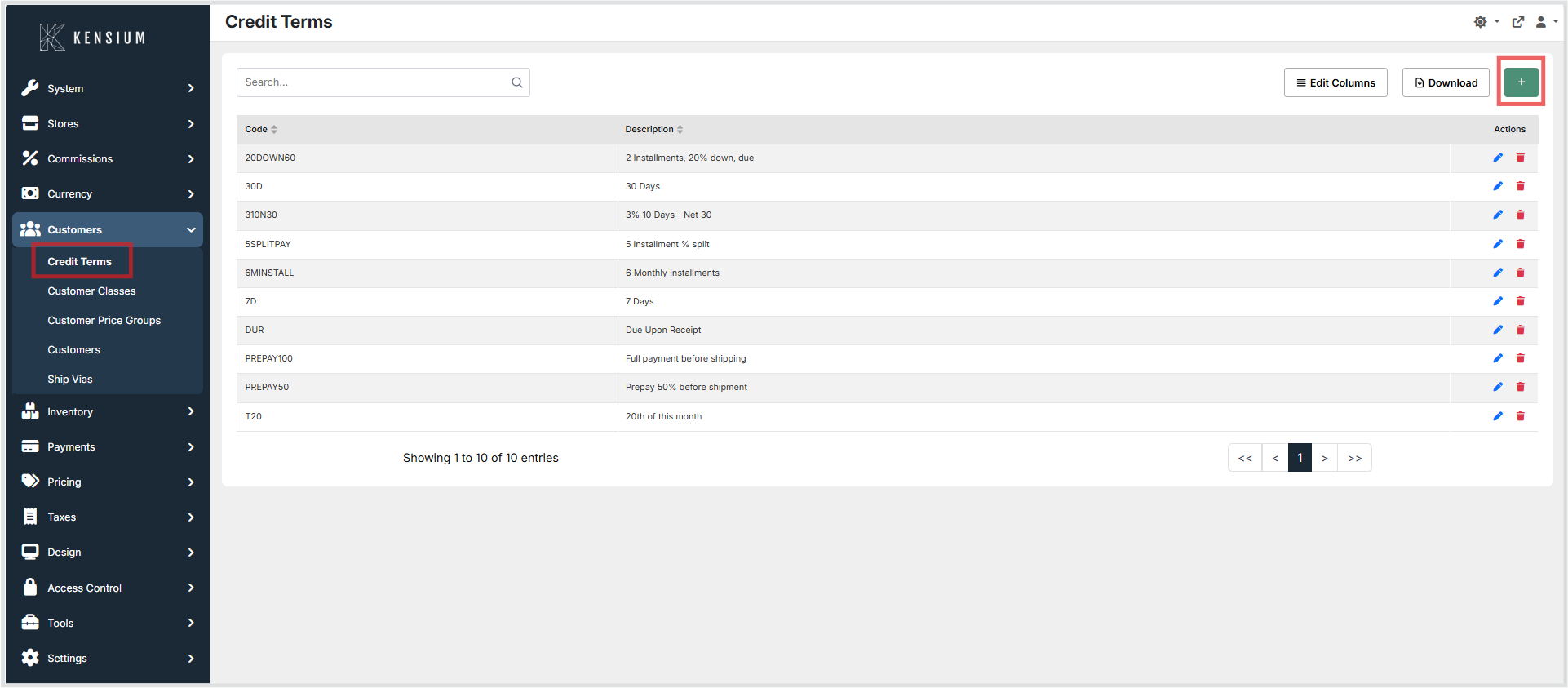
- Navigate to Customers → Credit Terms.
- Click the + button to create a new credit term, or choose an existing credit term to edit.
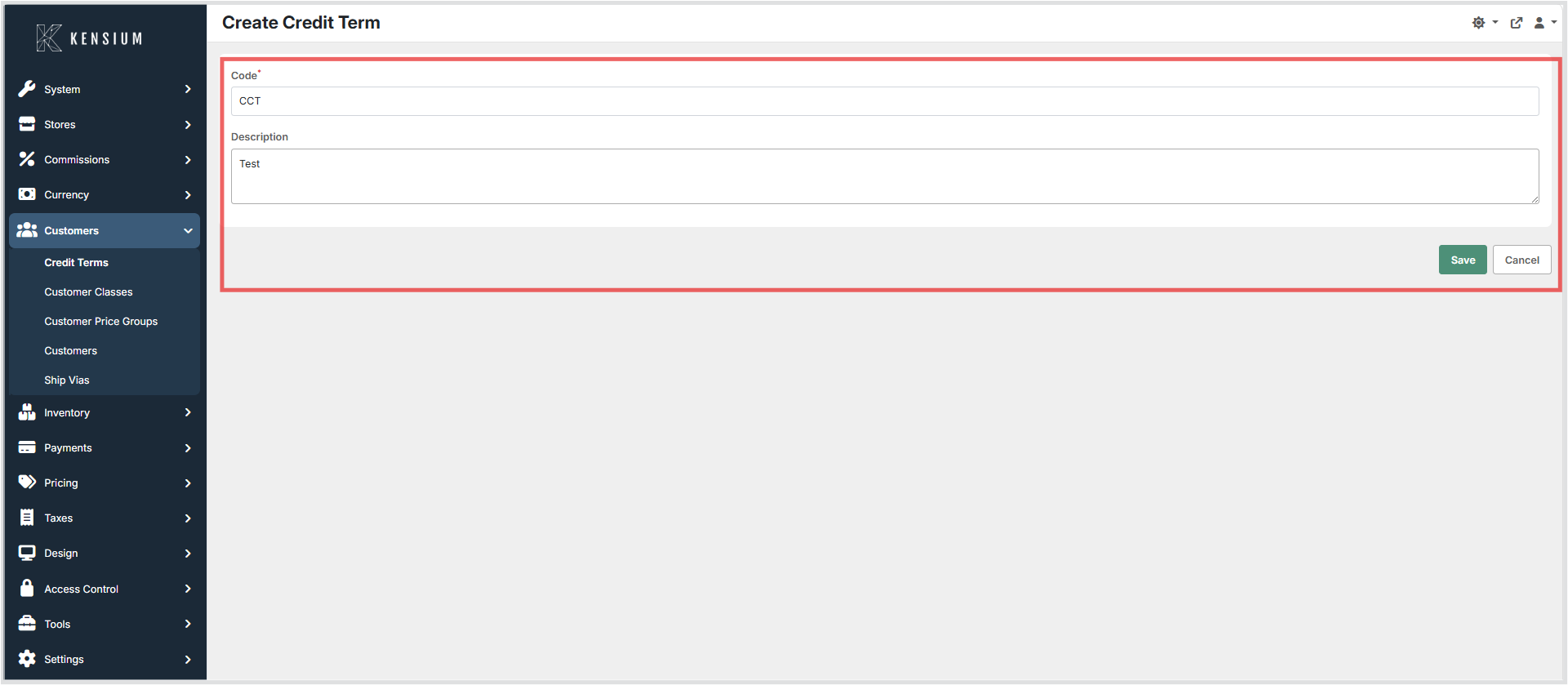
- Enter the required information.
- Click Save to apply the changes.
Available Fields
| Field | Description | Field Behavior |
|---|---|---|
| Code | Unique identifier used to represent the credit term within the system. | Required. The value must be unique and is used internally to reference the credit term across customer records and transactions. Once assigned to customer records, changing this value is not recommended as it may affect existing references. |
| Description | A descriptive explanation of the credit term to help administrators and users understand its purpose. | Optional. Displayed in the administrative interface to clarify when the credit term should be assigned. |
Operational Considerations
- Credit term codes should follow a consistent naming convention to maintain clarity across the system.
- Codes should remain stable after creation to preserve data integrity in existing customer and transaction records.
- Administrators should avoid creating duplicate codes that represent the same payment condition.
- Descriptions should clearly communicate the payment timeline and conditions associated with each term.
Example
| Code | Description |
|---|---|
30D |
30 Days |
DUR |
Due Upon Receipt |
310N30 |
3% 10 Days - Net 30 |
In this example, each code represents a distinct payment condition that can be assigned to customer records to communicate billing expectations for their transactions.